
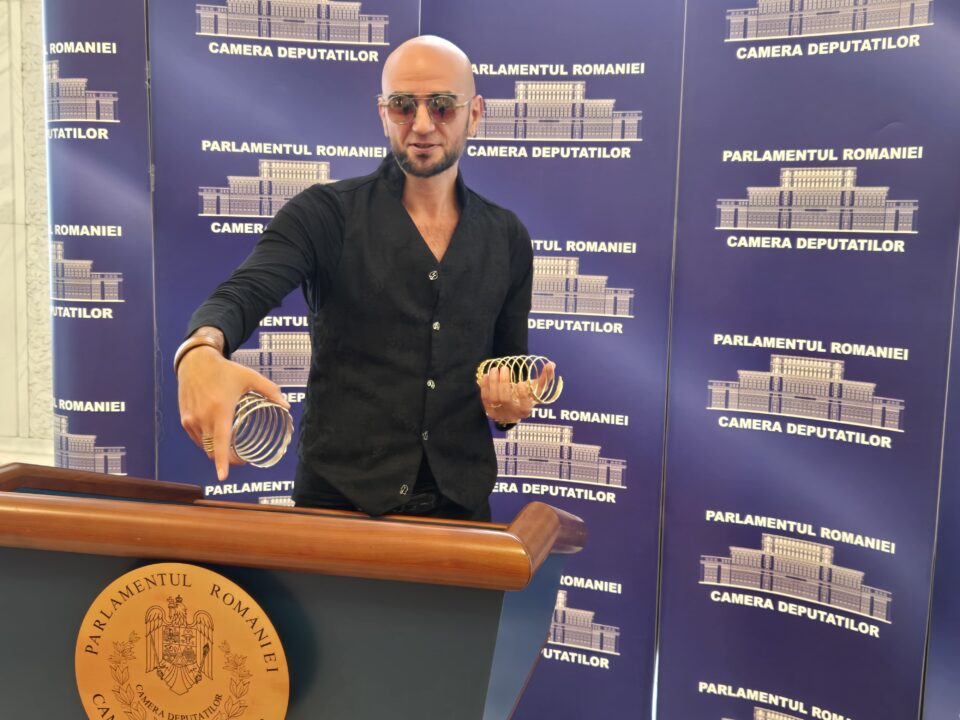
De la tehnica dentară și bijuteria modelată în ceară la reinterpretarea patrimoniului geto-dacic. Un dialog despre libertatea de a crea, rigoare istorică și proiectul internațional „Visioni Daciche”
◆
Pentru Kristian Dimofte, metalul nu este doar materie, iar obiectul artistic nu este doar formă. În creația sa, tehnicile precise deprinse în laboratorul de tehnică dentară se întâlnesc cu pasiunea pentru bijuterie, minisculptură și patrimoniul geto-dacic. Artistul vorbește despre drumul său neobișnuit, despre colecțiile „Tracia Amei” și „Getica”, despre reproducerea și reinterpretarea artefactelor istorice, dar și despre colaborarea cu Asociația „Spirit Românesc” în cadrul programului „Visioni Daciche”. Interviul conturează o viziune în care documentarea, meșteșugul și imaginația devin forme de continuitate culturală.
Interviu
1. Cine este Kristian Dimofte dincolo de ceea ce vedem într-un CV sau într-o expoziție? Cum v-ați defini ca artist?
Din perspectiva mea, toți suntem creatori, artiști. Copilăria este cel mai bun exemplu: în perioada purității noastre pe acest pământ, a crea și a fi creativ era o normalitate. În timp, unii au dezvoltat această abilitate, alții nu. Creând artă, mă simt liber. Ca să răspund simplu la întrebarea ta: sunt un om liber.
2. Aveți un traseu neobișnuit: jurnalism, tehnică dentară, haltere și artă. Cum s-au întâlnit toate aceste lumi în omul și artistul Kristian Dimofte?
Parcursul si căutările artistice au fost mai anevoioase. Din copilărie am început să cumpăr bijuterii, plus încercările mele disperate ca cineva să-mi facă bijuterii așa cum visam și le schițam în acea perioadă. Au fost ani la rând când pur și simplu am „terorizat” o doamnă bijutier din orașul meu natal, Galați. Când mă vedea că traversez strada spre atelierul dânsei, se ascundea sau le punea pe vânzătoare să mă mintă că nu este acolo.
Căutările în artă au continuat la Școala Populară de Artă din Galați. Am terminat cursurile de teatru, percuție, chitară clasică, iar în paralel făceam sport de performanță: haltere. Am participat chiar la două competiții naționale; la ultimul concurs am ieșit pe locul 13 din 14. Clar halterele nu erau de mine ca sportiv.
Am vrut să fac Conservatorul la secția percuție, dar simțeam în străfundul sufletului că nu voi fi atât de bun la asta. Simțeam eu că ceva zace în mine pe partea artistică, dar încă nu știam ce. Drumurile m-au dus către Facultatea de Filosofie și Jurnalism din București, în paralel cu Școala Națională de Antrenori.
Momentul culminant a fost după mulți ani, când am intrat într-un laborator de tehnică dentară — acolo s-a produs magia în capul meu! Am fost fascinat când am văzut cum un modelaj din ceară se poate transforma în metal. Atunci s-a produs conexiunea cu ce vorbeam mai sus: pasiunea mea pentru bijuterie și minisculptură. După mulți ani de tehnică dentară și mii de dinți făcuți, faptul că eram închis într-un laborator șase zile din șapte mă făcea să simt cum aripile nu-mi dau pace. Ele voiau să zboare, nu să stea închise în colivie.
3. Ați lucrat ca tehnician dentar, iar ulterior ați aplicat tehnici din acest domeniu în realizarea bijuteriilor. Care a fost momentul în care v-ați dat seama că o tehnică extrem de precisă poate deveni un instrument artistic?
Tehnica dentară este o artă în sine: niciun dinte nu este la fel. Transformarea unei forme de ceară în metal a fost momentul care m-a transferat înapoi în copilărie, iar de acolo a plecat tot. Având o imaginație bogată și gânduri mari, aici m-a adus.
4. Lucrați cu modelarea tradițională în ceară și cu procedeul cerii pierdute. Ce înseamnă, concret, drumul de la o idee sau o bucată de ceară până la obiectul final din metal?
Tehnica cerii pierdute este o tehnică străveche, folosită inclusiv de strămoșii noștri geto-daci. Până să încep a modela fizic, îmi schițez imaginar obiectul. Când consider că 3D-ul din capul meu este aproape gata, încep prin picurare (una din tehnicile folosite) sau sculptură. Totul pleacă din imaginație, creativitate, din acel copil din mine, și așa se produce magia.
5. Cât de importantă este pentru dumneavoastră execuția manuală într-o perioadă în care imprimarea 3D și tehnologiile digitale pot reproduce aproape orice formă?
Am simțit pe pielea mea această tehnologie: munca mea ca tehnician dentar a fost înlocuită de un aparat. Ce ține de partea artistică, cunoscătorii și iubitorii de artă știu bine diferența dintre manualitate și un obiect făcut pe calculator. Să nu uităm: omul sfințește locul și obiectele! Dar tehnologia ne poate ajuta să facem calcule precise, în cazul în care se cere asta.
LUMEA DACICĂ, PATRIMONIUL ȘI RIGOAREA ISTORICĂ
6. O parte importantă a creației dumneavoastră trimite la lumea geto-dacică și tracică. De unde a pornit această fascinație?
Este o chemare, nu doar o fascinație, o continuare a acestei tradiții în metale nobile. Cine știe, poate am mai făcut asta într-o viață anterioară!
7. Atunci când recreați o armă sau un obiect inspirat din Antichitate, unde se termină documentarea istorică și unde începe libertatea artistului?
În momentul în care fac o reproducere a unui artefact, creația artistică este deja făcută de meșterii de atunci, străbunii noștri. Încerc să-l înțeleg ca meșter, încât să pot readuce la viață acel obiect. În astfel de proiecte, partea mea creativă este de fapt cunoașterea. La finalul zilei, dacă ai învățat ceva nou, ești deja mai bun decât ieri.
8. Colecția „Tracia Amei” a fost prezentată în 2017 la Muzeul de Istorie „Paul Păltănea” din Galați și a intrat în Patrimoniul Național. Ce poveste se află în spatele acestei colecții și ce a însemnat pentru dumneavoastră recunoașterea ei?
Colecția „Tracia Amei” a fost confirmarea acestei chemări și momentul în care am conștientizat că pot face ceva semnificativ în viața mea, că pot lăsa o urmă a identității noastre urmașilor. Această colecție este și o dedicație soției mele, Ama este numele ei.
Povestea „Tracia Amei” este lungă și plină de semne, indicii, epifanii, o lungă listă de întâmplări și răspunsuri venite din „nicăieri”. Odată ce pui întrebări Universului, lui Dumnezeu, El îți va răspunde prin toate căile; doar a trebuit să fiu atent și să mulțumesc. Mai bine scriu o carte despre asta! Cu această ocazie, vreau să-i mulțumesc domnului director al Muzeului de Istorie „Paul Păltănea”, Cristian Căldăraru, pentru încrederea acordată de a crea această colecție.
9. În 2023 ați expus colecția „Getica” la Muzeul Național de Istorie a României, iar o sica din această colecție a fost donată muzeului. Cum s-a născut acel obiect?
Povestea ei este interesantă. A început în „pandemie”, fix în luna când ne-au închis în case trebuia să lansăm colecția pe piață. Eu și partenerii acestei colecții, Galeria Alexandra’s, am decis ca, pe toată durata acestei nebunii care s-a întâmplat pe tot pământul, să mărim colecția. Această veste a fost de bun augur.
Cu mulți ani înainte notasem ce idei aș vrea să mai creez pe viitor, iar una dintre ele era scrisă cu roșu și litere majuscule: SICA DACICA. Din acel moment, am căutat cel mai bun fierar din România pe arme istorice și așa l-am cunoscut pe Iamandi Cristian. El este omul care m-a introdus în această lume fascinantă a armelor dacice. Cu el am făcut toate armele dacice (și nu numai). Alături de el am creat o sica cu mâner din aur, patru din argint și două falxuri, într-o colaborare strânsă cu coordonatorul istoric Cătălin Borangic. Iamandi a fost cel care a venit cu propunerea să facem această sica după una originală de la Muzeul Național de Istorie a României. Așa a fost introdusă în colecție și ruptă ulterior pentru a fi donată muzeului.
10. Ce simte un artist în momentul în care o piesă creată de mâna lui trece din atelier în Patrimoniul Național al României? Se schimbă relația dumneavoastră cu acel obiect?
Relația cu acel obiect devine personală, exact ce spuneam mai sus despre cunoaștere. Îți imaginezi cum a făcut acel obiect, ce semnificație au simbolurile de pe el și multe alte întrebări. Așa intru într-o relație de comunicare cu acel obiect și cu momentul respectiv.
11. Expoziția „Sica de la Bulbuc” din 2025 a reunit arme istorice, bijuterie și obiecte de artă. De ce sica și ce vă fascinează la acest tip de armă?
Forma pumnalului este un simbol în sine al strămoșilor, la fel ca forma brățărilor spiralate dacice. Dacă sunt folosite unde trebuie, pot deveni branduri simbol de țară. Am avut onoarea să studiez și să readucem la viață, în adevărata ei splendoare, acest artefact ,”sfântul graal” al armelor dacice din țară. Mulțumesc oamenilor care au făcut posibilă această reînviere a meșteșugului, în special lui Iamandi Cristian, Cătălin Borangic și Cristian Căldăraru.
12. Când realizați asemenea piese, urmăriți reconstituirea cât mai fidelă a unui obiect istoric sau încercați să transmiteți și propria interpretare asupra lumii din care acesta provine?
Când fac o reproducere, încerc să o aduc cât mai aproape de adevăr. Iar în zona artistică și liberă, vă dau exemplul colecției Getica. Totul a plecat de la o întrebare: Cum ar fi arătat bijuteriile și podoabele dacice în secolul nostru dacă strămoșii și noi nu am fi oprit acest meșteșug? Așa iau viață lucrările mele pe tema strămoșilor.
13. Ce ne pot spune armele și bijuteriile despre geto-daci și traci pe care izvoarele scrise nu reușesc să ne spună?
Bijuteriile, armele, sticla, instrumentele medicale și lista continuă ne arată clar că vorbim despre o civilizație mult mai avansată decât știm. Detaliile și precizia obiectelor din aur sunt spectaculoase. Vorbim despre multe tipuri de tehnici, inclusiv mixte, matrițe de bijuterii (exemplul cel mai bun fiind Matrița de la Sarmizegetusa). Avem cel mai vechi aur din Europa! Trebuie scos la lumină prin astfel de manifestări artistice. Dacă astfel de proiecte ar fi susținute financiar și in presă, am deveni ambasadori ai României destul de puternici.
14. Există riscul să idealizăm lumea dacilor și tracilor atunci când o reinterpretăm artistic? Cum separați documentarea istorică de mitologie și de imaginarul modern?
De ce ar fi un risc să ne uităm cu demnitate la strămoșii noștri, exact așa cum ne privim părinții și bunicii? Cum am răspuns și mai sus: în proiectele de strictă reproducere există rigoarea istorică, iar ce ține de mitologie și imaginarul modern se adaptează perfect altor proiecte sau colecții. De exemplu, în colecția Getica, la lucrarea „Rugăciunea unui Dac”, am scris prin modelare pe toată circumferința spiralei brățării a treia strofă din poezia lui Mihai Eminescu. Se îmbină perfect trecutul cu prezentul și chiar sunt aduse în viitor; având acest trio, pot ieși lucrări excelente.
15. Ați expus de la București și Galați până la Birmingham și Barcelona. Ce diferențe ați observat între felul în care publicul românesc și cel străin reacționează la lucrările dumneavoastră?
Din păcate, până acum lucrările mele pe tema străbunilor noștri nu au avut ocazia să călătorească în afara granițelor țării, deci nu am o reacție oficială a publicului străin pe această temă. Pe altfel de lucrări am un feedback excelent, atât în afara granițelor, cât și în România. Ce am observat în România este că oamenii încă mai au reminiscențe din comunism: de la Dej până în ’89, noi, românii, nu am avut voie să deținem sau să prelucrăm metale prețioase. Aici a fost o ștergere a identității noastre străvechi.
COLECȚII, TEHNICI ȘI EXPRESIE ARTISTICĂ
16. În expoziția personală „They Live” din 2025 ați pus împreună tablouri, arme istorice, bijuterii și obiecte de artă. Ce înseamnă titlul „They Live” și cine sunt, de fapt, cei care „trăiesc”?
„They Live” este o serie de tablouri și sculpturi abstracte, unele chiar inspirate din mitologie. Încă nu am făcut ceva pe tema strămoșilor acolo, dar vreau să găsesc momentul potrivit să fac o colecție de tablouri pe tema Cucuteni. Au fost aduse la această expoziție și câteva obiecte dacice, la insistențele directorului galeriei. Au vrut neapărat o brățară dacică și o sica. Neapărat!
Tema expoziției este legată de filmul „They Live” din anul 1988, regizat de John Carpenter. Dacă sunteți curioși de ce am ales acest titlu, urmăriți filmul.
17. Există o piesă dintre toate cele realizate până acum de care vă este foarte greu să vă despărțiți? Care este povestea ei?
Am învățat în decursul anilor să nu mă mai atașez de lucrări sau de obiecte materiale. Eu știu că tot ce iese de pe mâna mea își are clientul, povestea sau călătoria ei. Cu gândul ăsta am și mai multă libertate în a crea. Am totuși câteva lucrări personale pe care le folosesc aproape zilnic: prima pereche de ochelari făcută de mine (încă sunt surprins cât au rezistat prin câte au trecut!) și o brățară sub formă de sârmă ghimpată, printre primele mele lucrări făcute din metal medicinal.
18. Câtă muncă nevăzută există în spatele unui singur obiect, documentare, desen, modelare, turnare, prelucrare, finisare, înainte ca publicul să îl vadă într-o vitrină?
Sunt lucrări care au durat luni de zile. Am câteva piese documentate de la punctul zero până la final. Una dintre ele este „Sburătorul”, inspirată din opera lui Ion Heliade-Rădulescu: modelarea în ceară și aducerea ei în metal a durat aproximativ 980 de ore. Am făcut lucrări și mai complexe și de durată, dar sunt și lucrări făcute relativ rapid. Bineînțeles, lucrez și pe termen stabilit. Partea creativă se produce în mintea mea, nu obișnuiesc să schițez. Când mi se conturează ideea, intru direct în acțiune.
19. Dacă ați avea acces nelimitat la resurse și la cele mai importante descoperiri arheologice, ce obiect sau ce colecție legată de lumea geto-dacică ați visa să realizați?
Un mic vis ar fi să realizez o brățară dacică de dimensiuni uriașe în Piața Constituției din București.
20. Peste o sută de ani, dacă cineva ar descoperi o lucrare semnată Kristian Dimofte fără să știe nimic despre autorul ei, ce ați vrea să înțeleagă despre omul și epoca în care a fost creată?
Peste o sută de ani sigur vor fi cele din muzeele de astăzi. Se va înțelege această continuitate de care am vorbit și mai sus.
COLABORAREA CU ASOCIAȚIA SPIRIT ROMÂNESC ȘI PROIECTUL „VISIONI DACICHE”
21. Cum a început colaborarea dumneavoastră cu Asociația Spirit Românesc și ce v-a determinat să vă alăturați programului internațional „Visioni Daciche”?
În primăvara acestui an am întâlnit oamenii din Asociația „Spirit Românesc” la un eveniment internațional de artă contemporană, MOBU. Mare mi-a fost surprinderea să văd că în centrul evenimentului tronau imagini cu strămoșii noștri de pe Columnă, Forul lui Traian și Arcul lui Constantin. Foarte rar sau deloc se întâmplă ca la un eveniment de artă contemporană să se promoveze cultul strămoșesc, iconografia dacilor sau ceva legat de ei.
Văzând câtă pasiune există în președinta asociației, Dana Mihalache, și în Leonard Velcescu, am hotărât să-i abordez și să le arăt pasiunea mea pentru bijuteriile și armele dacice. Partea interesantă este că mă hotărâsem cu trei zile înainte de acest eveniment să înlocuiesc lucrările abstracte cu brățări dacice! Nimic nu este întâmplător în această viață. Între noi a fost o conexiune puternică și așa am fost invitat să intru în această asociație.
22. „Visioni Daciche” pornește de la iconografia dacilor din Forul lui Traian și încearcă să creeze un dialog între cercetarea istorică, patrimoniul arheologic și creația contemporană. Unde simțiți că se întâlnește cel mai bine universul dumneavoastră artistic cu această viziune?
Se completează de minune! Având capacitatea de a readuce la viață multe obiecte din toată iconografia dacilor (și nu numai), sunt încântat să fac acest pas spre cunoaștere și spre împărtășirea cultului strămoșesc.
23. În cadrul programului „Visioni Daciche”, lucrările dumneavoastră intră în dialog cu statuile de daci, reliefurile și celelalte reprezentări păstrate în monumentele Romei. Cum abordați transpunerea unor asemenea surse iconografice într-un obiect contemporan?
Abordarea mea este în strânsă colaborare cu domnii Leonard Velcescu și Cătălin Borangic, pentru a avea sprijinul și coordonarea lor istorică. Ce ține de aducerea lor în contemporan, ador să le transform și să le readuc în secolul nostru.
24. Pentru un artist român, ce înseamnă posibilitatea de a prezenta creații inspirate de lumea geto-dacică la Roma, chiar în orașul în care se păstrează unele dintre cele mai importante reprezentări antice ale dacilor?
Nu m-am gândit la acest aspect, îmi place să fiu surprins! Sunt sigur însă că voi avea o conexiune puternică cu locurile și artefactele dacice din Roma.
25. Considerați că asocierea dintre cercetarea științifică și creația artistică poate ajuta publicul să privească altfel statuile dacilor din Forul lui Traian, nu doar ca monumente ale Antichității, ci ca surse pentru înțelegerea unei civilizații?
Da, fără îndoială. O parte din cercetarea științifică este făcută pe baza sculpturilor, bijuteriilor, armelor ș.a.m.d. — adică pe bază de artă. Să nu uităm: arta este memorie! Prin arta străveche noi le decodificăm secretele, tradiția, religia etc. Aceste proiecte pe care le gândim în Asociația „Spirit Românesc” sunt memorii pe care le interpretăm și le ducem mai departe. Artă = Memorie.
26. Colaborarea cu Spirit Românesc presupune și prezentarea acestui patrimoniu unui public internațional. Cum credeți că poate fi spusă povestea dacilor în afara României fără a cădea nici în discursul excesiv identitar, nici într-o simplă reconstituire istorică?
Povestea continuă prin noi, asta mi se pare fascinant! Ce ține de discurs, voi gândi în așa fel încât să explic scurt și concis o paralelă între tehnica folosită atunci și cea de acum, rolul lor fiind un aspect important în acest proiect. Prefer să nu vorbesc foarte mult ca să nu intrăm într-o zonă anostă. Lucrările vor vorbi de la sine, atâta timp cât vor fi prezentate impecabil.
27. Programul „Visioni Daciche” își propune să apropie cercetători, artiști, muzee, instituții culturale și publicul larg. Ce poate aduce artistul într-un asemenea dialog pe care cercetătorul sau muzeul, prin natura lor, nu îl pot aduce în aceeași formă?
Pasiunea față de prelucrarea metalelor! Puțini pun accent pe acest subiect.
28. Cum vedeți rolul obiectelor create de dumneavoastră într-o expoziție dedicată iconografiei dacilor: reconstituiri, interpretări artistice, instrumente de mediere culturală sau o punte între toate acestea?
O văd ca pe o întregire a proiectului. În momentul când ne vom permite să facem toate accesoriile de pe Columnă (inclusiv din armata romană și auxiliarii lor), va deveni un proiect de talie mondială din toate punctele de vedere. Așa vom stârni și curiozitatea altor muzee, galerii sau evenimente de pe toate continentele.
29. Una dintre direcțiile programului este implicarea tinerilor și a elevilor în descoperirea patrimoniului dacic de la Roma. V-ar interesa ca, pe viitor, să susțineți în cadrul „Visioni Daciche” demonstrații, ateliere sau întâlniri în care tinerii să poată urmări efectiv nașterea unui obiect, de la documentare și modelarea în ceară până la metal?
Este o idee excelentă! Chiar încerc ceva de genul ăsta în România, dar se pare că nu este un interes atât de mare pe această temă, din păcate. Sunt foarte deschis să fac demonstrații sau ateliere în această direcție, poate chiar și cursuri de bijuterie pentru românii din Italia. Prin asociație putem îndeplini multe proiecte spre a învăța și a ajuta oamenii.
30. Dacă ar trebui să concepeți o piesă specială pentru „Visioni Daciche”, inspirată exclusiv din iconografia dacilor din Forul lui Traian, ce element v-ar provoca cel mai mult: armele, vestimentația, bijuteriile, fizionomia personajelor sau simbolistica reprezentărilor? De ce?
Eu aș dori ca toată colecția pe care o am, plus ce voi face pentru acest proiect, să rămână în Asociația „Spirit Românesc”, atâta timp cât vor continua cu promovarea cultului și spiritului românesc.
Unele beneficii pentru Asociația „Spirit Românesc” ar fi:
Statut clar de bun cultural: Un ONG poate obține mai ușor de la Ministerul Culturii clasarea bunului în categoria Fond sau Tezaur, oferind operei un statut de protecție specială și o cotație internațională crescută.
Atragerea de granturi dedicate bunurilor culturale: ONG-ul poate aplica pentru fonduri nerambursabile (AFCN, granturi elvețiene/norvegiene) specifice digitalizării, restaurării sau catalogării operelor de artă deținute. Aceste granturi nu pot fi accesate de colecționari privați persoane fizice.
Lista continuă.
31. Vedeți posibilitatea dezvoltării, împreună cu Spirit Românesc, a unei colecții originale „Visioni Daciche”, construită pe baza documentării arheologice și iconografice realizate în cadrul programului? Cum v-ați imagina o asemenea colecție?
Deja o pregătim. Să lăsăm și misterul să-și facă magia!
32. Programul își propune să circule în timp între Roma, România și alte spații culturale europene. Cât de important ar fi pentru dumneavoastră ca lucrările realizate în această colaborare să devină parte a unor expoziții itinerante și a unui dialog cultural european despre patrimoniul comun?
Este foarte important, după cum am scris și mai sus.
33. După experiențele dumneavoastră de la Galați, București, Birmingham sau Barcelona, ce credeți că ar trebui să facă „Visioni Daciche” pentru a transforma tema dacilor dintr-un subiect perceput uneori ca predominant românesc într-o temă de interes cultural și istoric european? Cum vedeți evoluția colaborării cu Asociația Spirit Românesc?
Sunt atâtea căi să facem vizibil acest subiect! De la evenimente internaționale de bijuterie, până la evenimente culturale cu alte țări. De exemplu: putem face un proiect cu un institut din Japonia, o paralelă între falxul dacic și katana, chiar sunt câteva puncte similare! Plus că, în unele țări asiatice, la aceste evenimente se taxează intrarea, așadar asociația va câștiga un procent din vânzare (și să nu uităm că vorbim de peste 100.000 de vizitatori pe lună). Dacă se va ajunge cu un eveniment pe tema dacilor în Asia, pentru ei va fi un subiect exotic. Imaginație și voință să avem, idei se găsesc!
34. Dacă „Visioni Daciche” ar deveni peste câțiva ani o platformă internațională permanentă dedicată cercetării și valorificării iconografiei dacilor, care ați dori să fie contribuția lui Kristian Dimofte la această construcție?
Fără „dacă”! Bănuiesc că voi pune umărul să ajungă cât mai rapid acolo.
ÎNTREBAREA DE FINAL
35. Dacă ar trebui să transmiteți printr-un singur obiect creat pentru „Visioni Daciche” un mesaj publicului de peste o sută de ani despre daci, despre Roma și despre dialogul dintre culturile noastre, cum ar arăta acel obiect și ce ați dori să spună?
Ar fi acea sculptură de dimensiuni mari din Piața Constituției. Iar pentru Roma aș face Laurii lui Traian, la dimensiuni cât mai aproape de adevărul istoric.
„Arta este memorie.”
________
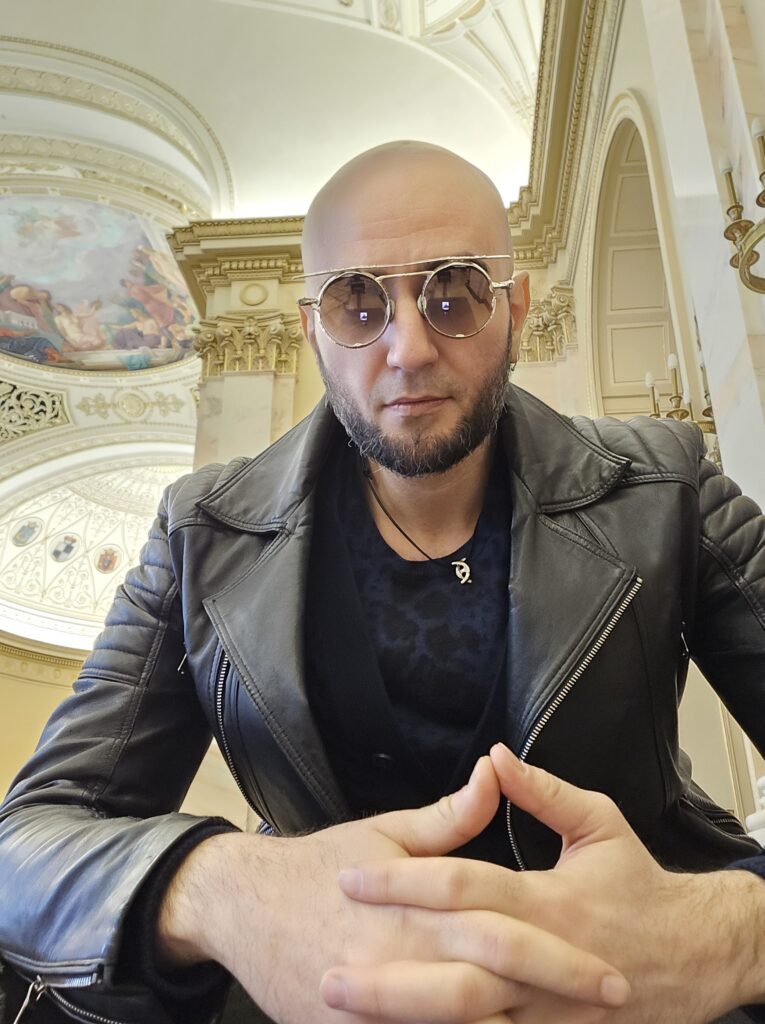
Kristian Dimofte: “Art Is Memory”
From dental technology and wax-modelled jewellery to the reinterpretation of Geto-Dacian heritage. A conversation about the freedom to create historical rigor and the international “Visioni Daciche” project
◆
For Kristian Dimofte, metal is more than a material, and a work of art is more than a form. In his work, the precise techniques he learned in a dental laboratory meet his passion for jewellery, miniature sculpture and Geto-Dacian heritage. The artist talks about his unusual path, the “Tracia Amei” and “Getica” collections, the reproduction and reinterpretation of historical artefacts, and his collaboration with the Spirit Românesc Association through the “Visioni Daciche” programme. The interview traces a vision in which research, craftsmanship and imagination become ways of carrying a culture forward.
Interview
1. Who is Kristian Dimofte beyond what we see in a CV or at an exhibition? How would you define yourself as an artist?
The way I see it, we are all creators and artists. Childhood is the best example. In that innocent time in our lives, creating and being creative came naturally. Over time, some people developed that ability and others did not. When I make art, I feel free. To answer your question simply, I am a free man.
2. You have followed an unusual path through journalism, dental technology, weightlifting and art. How did these worlds come together in Kristian Dimofte, the person and the artist?
Finding my way as an artist was more of a struggle. I started buying jewellery as a child, and I tried desperately to find someone who could make the pieces I dreamed up and sketch back then. For years I practically “terrorized” a jeweler in my hometown of Galați. When she saw me crossing the street towards her workshop, she would hide or tell her sales assistants to say she wasn’t there.
I continued exploring the arts at the Folk School of Arts in Galați. I completed courses in theatre, percussion and classical guitar while also training as a competitive weightlifter. I even took part in two national competitions. In the last one I came 13th out of 14. Clearly, competitive weightlifting wasn’t for me.
I wanted to study percussion at the conservatoire, but deep down I felt I wouldn’t be very good at it. I sensed there was something artistic in me, but I still didn’t know what it was. I ended up at the Faculty of Philosophy and Journalism in Bucharest while also attending the National School for Coaches.
The turning point came many years later, when I walked into a dental laboratory. That’s where the magic happened in my head! I was fascinated to see how something modelled in wax could be turned into metal. That was when I made the connection with the passion I mentioned earlier, for jewellery and miniature sculpture. After years in dental technology and thousands of teeth made, being shut in a lab six days a week made me feel my wings wouldn’t give me any peace. They wanted to fly, not stay locked in a cage.
3. You worked as a dental technician and later applied techniques from that field to jewellery making. When did you realise that an extremely precise technique could become an artistic tool?
Dental technology is an art in itself. No two teeth are alike. Seeing a wax form turn into metal took me straight back to childhood, and that’s where it all began. A vivid imagination and big ideas brought me here.
4. You work with traditional wax modelling and lost-wax casting. In practical terms, what does it take to go from an idea or a piece of wax to the finished metal object?
Lost-wax casting is an ancient technique that our Geto-Dacian ancestors used as well. Before I start modelling, I sketch the object in my mind. Once the three-dimensional form in my head is nearly complete, I begin by building it up with drops of wax, which is one technique I use, or by carving it. It all starts with imagination and creativity, with that child in me. That’s how magic happens.
5. How important is making things by hand to you at a time when 3D printing and digital technologies can reproduce almost any shape?
I felt the impact of that technology firsthand. A machine replaced the work I did as a dental technician. In art, connoisseurs and art lovers know the difference between a handmade piece and one made on a computer. Let’s remember that it’s people who bring places and objects to life! Technology can, of course, help us make precise calculations when they’re needed.
THE DACIAN WORLD, HERITAGE AND HISTORICAL RIGOUR
6. Much of your work evokes the Geto-Dacian and Thracian worlds. Where did that fascination begin?
It’s calling, more than a fascination. It’s a way of carrying on this tradition in precious metals. Who knows? Maybe I did this in my previous life!
7. When you recreate a weapon or an object inspired by antiquity, where does historical research end and artistic freedom begin?
When I reproduce an artefact, the artistic work has already been done by our ancestors, the craftspeople of that time. I try to understand it as a craftsperson so I can bring it back to life. In projects like these, the creative part for me is what I learn. At the end of the day, if you’ve learned something new, you’re already better than you were yesterday.
8. The “Tracia Amei” collection was presented in 2017 at the Paul Păltănea History Museum in Galați and became part of Romania’s National Heritage. What is the story behind the collection, and what did that recognition mean to you?
“Tracia Amei” confirmed that calling. It was when I realized I could do something meaningful with my life and leave a trace of our identity for future generations. The collection is also dedicated to my wife, whose name is Ama.
The story of “Tracia Amei” is long and full of signs, clues and epiphanies, a whole series of events and answers that came out of “nowhere”. Once you ask questions of the Universe, of God, He will answer you in all sorts of ways. I just had to pay attention and give thanks. I might as well write a book about it! I’d like to take this opportunity to thank Cristian Căldăraru, director of the Paul Păltănea History Museum, for trusting me to create this collection.
9. In 2023, you exhibited your “Getica” collection at the National Museum of Romanian History, and a sica from the collection was donated to the museum. How did that piece come about?
It has an interesting story. It began during the pandemic. We were supposed to launch the collection in the very month we went into lockdown. My partners on the collection, Alexandra’s Gallery, and I decided to expand it while all this madness was going on around the world. That turned out to be a good thing.
Years before, I’d written down ideas for pieces I wanted to make one day. One was in red capital letters: DACIAN SICA. I set out to find Romania’s best blacksmith specializing in historical weapons, and that’s how I met Iamandi Cristian. He introduced me to the fascinating world of Dacian weapons. We made all the Dacian weapons together, as well as others. With him I made a gold-hilted sica, four in silver and two falxes, working closely with Cătălin Borangic, who oversaw the historical work. Iamandi suggested basing this particular sica on an original at the National Museum of Romanian History. That’s how it became part of the collection before being set aside and donated to the museum.
10. How does it feel when a piece you made by hand goes from your workshop into Romania’s National Heritage? Does your relationship with the object change?
My relationship with the object becomes personal. It goes back to what I said about learning. I imagine how the original maker made it and ask myself what its symbols mean, among many other questions. That’s how I enter into a dialogue with the object and the time it came from.
11. The 2025 exhibition “Sica de la Bulbuc” brought together historical weapons, jewellery and art objects. Why the sica, and what fascinates you about this type of weapon?
The shape of the dagger is itself a symbol of our ancestors, just like the shape of Dacian spiral bracelets. Used in the right settings, they could become recognizable symbols of Romania. I had the honors of studying this artefact and helping bring it back to life in all its splendor. It’s the “Holy Grail” of Dacian weapons in Romania. I thank everyone who made this revival of the craft possible, especially Iamandi Cristian, Cătălin Borangic and Cristian Căldăraru.
12. When you make pieces like these, do you aim to reconstruct a historical object as faithfully as possible, or do you also try to convey your own interpretation of the world it came from?
When I make a reproduction, I try to make it as true to the original as possible. As for work where I have more artistic freedom, take the Getica collection. It all started with a question. What would Dacian jewellery and adornments look like in our century if the craft had been passed down from our ancestors uninterrupted? That’s how my work about our ancestors comes to life.
13. What can weapon and jewellery tell us about the Geto-Dacians and Thracians that written sources cannot?
Jewellery, weapons, glass, medical instruments and many other objects make it clear that we’re talking about a civilization far more advanced than we realize. The detail and precision of the gold objects are spectacular. We see a wide range of techniques, some used in combination, as well as jewellery moulds, the best example being the Sarmizegetusa Mould. We have the oldest gold in Europe! Artistic events like these can bring it to public attention. With funding and support from the press for such projects, we could become quite effective ambassadors for Romania.
14. Is there a risk of idealising the Dacian and Thracian worlds when we reinterpret them artistically? How do you distinguish historical research from mythology and the modern imagination?
Why would it be a risk to look upon our ancestors with the same respect we show our parents and grandparents? As I said earlier, strict reproduction calls for historical rigour, while mythology and the modern imagination are perfectly suited to other projects or collections. For example, for “Rugăciunea unui Dac” (“A Dacian’s Prayer”) in the Getica collection, I modelled the words of the third stanza of Mihai Eminescu’s poem along the full length of the bracelet’s spiral. Past and present come together seamlessly and are carried into the future. Bringing those three together can produce excellent work.
15. You have exhibited in places ranging from Bucharest and Galați to Birmingham and Barcelona. What differences have you noticed between how Romanian and international audiences respond to your work?
Unfortunately, my work about our ancestors hasn’t yet had a chance to travel abroad, so I don’t have a formal response from international audiences on that subject. My other work has received excellent feedback abroad and in Romania. What I’ve noticed in Romania is that the legacy of communism still lingers. From the Dej era until ’89, we Romanians weren’t allowed to own or work with precious metals. That erased part of our ancient identity.
COLLECTIONS, TECHNIQUES AND ARTISTIC EXPRESSION
16. Your 2025 solo exhibition “They Live” brought together paintings, historical weapons, jewellery and art objects. What does the title mean, and who exactly are “they”?
“They Live” is a series of abstract paintings and sculptures, some inspired by mythology. I haven’t explored the subject of our ancestors in that series yet, but I want to find the right moment to make a series of paintings about the Cucuteni culture. A few Dacian objects were brought into the exhibition at the gallery director’s insistence. They absolutely wanted a Dacian bracelet and a sica. Absolutely!
The exhibition’s theme is linked to the 1988 film “They Live”, directed by John Carpenter. If you’re curious about why I chose the title, watch the film.
17. Of all the pieces you’ve made so far, is there one you would find especially hard to part with? What’s its story?
Over the years I’ve learned to let go of my work and of material things. I know that everything I make has a customer, a story or a journey of its own. Thinking that way gives me even more freedom to create. I do have a few personal pieces I use almost daily. There’s the first pair of glasses I made, and I’m still surprised they’ve passed through everything they’ve been through! I also have a bracelet shaped like barbed wire, one of my first pieces in medical-grade metal.
18. How much work goes unseen in a single object, from research, drawing and modelling to casting, metalworking and finishing, before the public sees it in a display case?
Some pieces have taken months. I’ve documented a few from start to finish. One is “Sburătorul”, inspired by the work of Ion Heliade-Rădulescu. Modelling it in wax and turning it into metal took about 980 hours. I’ve made pieces that were more complex and took longer, and others that came together fairly quickly. Of course, I also work to deadlines. The creative part happens in my head. I don’t usually make sketches. Once the idea takes shape, I get straight to work.
19. If you had unlimited resources and access to the most important archaeological discoveries, what object or collection inspired by the Geto-Dacian world would you dream of making?
A little dream would be to make a gigantic Dacian bracelet in Constitution Square in Bucharest.
20. If someone a hundred years from now discovered a work signed by Kristian Dimofte and knew nothing about its maker, what would you want them to understand about the person who made it and the time in which it was made?
A hundred years from now, I’m sure the pieces in museums today will still be there. People will understand the continuity I spoke about earlier.
COLLABORATION WITH THE SPIRIT ROMÂNESC ASSOCIATION AND THE “VISIONI DACICHE” PROJECT
21. How did your collaboration with the Spirit Românesc Association begin, and what prompted you to join the international “Visioni Daciche” programme?
This spring I met the people from the Spirit Românesc Association at MOBU, an international contemporary art event. To my great surprise, at the centre of the event were prominent images of our ancestors from Trajan’s Column, Trajan’s Forum and the Arch of Constantine. It’s very rare, if it happens at all, for a contemporary art event to celebrate the veneration of our ancestors, Dacian iconography or anything connected with the Dacians.
When I saw how passionate the association’s president, Dana Mihalache, and Leonard Velcescu were, I decided to approach them and share my passion for Dacian jewellery and weapons. The interesting thing is that just three days before the event, I’d decided to swap my abstract works for Dacian bracelets! Nothing in this life happens by chance. We connected immediately, and that’s how I was invited to join the association.
22. “Visioni Daciche” takes the iconography of the Dacians in Trajan’s Forum as its starting point and seeks to create a dialogue between historical research, archaeological heritage and contemporary art. Where do you feel your own artistic world connects most closely with that vision?
They complement each other beautifully! I can bring many objects depicted in Dacian iconography and beyond back to life, and I’m excited to take this step towards learning more and sharing the tradition of honouring our ancestors.
23. In “Visioni Daciche”, your work enters into dialogue with statues of Dacians, reliefs and other depictions preserved on Rome’s monuments. How do you approach translating such visual sources into a contemporary object?
I work closely with Leonard Velcescu and Cătălin Borangic, who give me support and historical guidance. When it comes to making these objects contemporary, I love transforming them and bringing them into our own century.
24. As a Romanian artist, what does it mean to have the opportunity to present work inspired by the Geto-Dacian world in Rome, the very city where some of the most important ancient depictions of the Dacians are preserved?
I haven’t thought about that side of it. I like being surprised! I’m sure, though, that I’ll feel a strong connection to the places and Dacian artefacts in Rome.
25. Do you think bringing scholarly research and artistic creation together can help audiences see the Dacian statues in Trajan’s Forum differently, as sources for understanding a civilization as well as monuments from antiquity?
Yes, without a doubt. Some scholarly research draws on sculpture, jewellery, weapons and so on. In other words, it draws on art. Let’s remember that art is memory! Through ancient art we decipher their secrets, their traditions, their religion and more. The projects we develop at the Spirit Românesc Association are memories that we interpret and carry forward. Art = Memory.
26. Your collaboration with Spirit Românesc also involves presenting this heritage to an international audience. How can the story of the Dacians be told outside Romania without putting too much emphasis on national identity or reducing it to historical reconstruction?
The story carries on through us, and I find that fascinating! When I speak, I’ll find a concise way to draw a parallel between the techniques used then and those used today. The role of those techniques is an important part of the project. I prefer to keep it short, so it doesn’t get dull. The pieces will speak for themselves, provided they’re presented impeccably.
27. “Visioni Daciche” aims to bring researchers, artists, museums, cultural institutions and the public together. What can an artist contribute to that dialogue in a way that a researcher or a museum cannot?
A passion for metalworking! Few people give it much attention.
28. How do you see the role of your pieces in an exhibition on Dacian iconography? Are they reconstructions, artistic interpretations, ways of helping audiences engage with the culture, or a bridge between all of these?
I see them as completing the project. Once we can afford to make all the accessories shown on the Column, including those of the Roman army and its auxiliaries, it will become a world-class project in every respect. That will also spark interest from other museums, galleries and events on every continent.
29. One of the programme’s aims is to involve young people and school pupils in discovering Rome’s Dacian heritage. Would you be interested in holding demonstrations, workshops or sessions through “Visioni Daciche” so young people can see an object take shape, from research and wax modelling through to the finished metal piece?
It’s an excellent idea! I’m trying something like that in Romania, but unfortunately there doesn’t seem to be that much interest. I’d be very happy to hold demonstrations or workshops along those lines, perhaps even jewellery-making courses for Romanians in Italy. Through the association, we can undertake many projects that help us learn and help others.
30. If you were to design a special piece for “Visioni Daciche” inspired solely by the depictions of Dacians in Trajan’s Forum, what would challenge you most and why? The weapons, the clothing, the jewellery, the figures’ facial features or the symbolism of the depictions?
I’d like my entire collection, along with what I make for this project, to remain with the Spirit Românesc Association for as long as it continues to promote the tradition of honoring our ancestors and the Romanian spirit.
Some of the benefits for the Spirit Românesc Association would include the following.
Formal cultural property status. An NGO can more readily obtain classification from the Ministry of Culture in the Fund (Fond) or Treasury (Tezaur) category, giving the work special protection and increasing its international market value.
Access to grants for cultural property. The NGO can apply for non-repayable funding, such as AFCN funding or Swiss and Norwegian grants, to digitize, restore or catalogue works of art it owns. These grants are unavailable to individual private collectors.
The list goes on.
31. Could you see yourself developing an original “Visioni Daciche” collection with Spirit Românesc, drawing on the archaeological and iconographic research carried out through the programme? How would you imagine that collection?
We’re already working on it. Let’s leave a little mystery to work its magic!
32. Over time, the programme is intended to travel between Rome, Romania and other European cultural settings. How important would it be to you for works made through this collaboration to become part of travelling exhibitions and a European cultural dialogue about shared heritage?
It’s very important, as I said earlier.
33. Drawing on your experiences in Galați, Bucharest, Birmingham and Barcelona, what do you think “Visioni Daciche” should do to make the Dacians a subject of European cultural and historical interest when they are sometimes seen as a predominantly Romanian topic? How do you see the collaboration with the Spirit Românesc Association developing?
There are so many ways to draw attention to this subject, from international jewelers events to cultural events with other countries. We could do a project with an institute in Japan, for example, exploring parallels between the Dacian falx and the katana. There really are some similarities! In some Asian countries these events charge admission, so the association would receive a percentage of ticket sales. And remember, we talk about more than 100,000 visitors a month. If an event about the Dacians makes it to Asia, the subject will be exotic to audiences there. All we need is imagination and the will to do it. The ideas will come!
34. If “Visioni Daciche” were to become a permanent international platform in a few years’ time for studying and promoting Dacian iconography, what would you like Kristian Dimofte’s contribution to be?
No “if” about it! I expect I’ll do my part to help it get there as quickly as possible.
FINAL QUESTION
35. If you had to create a single object for “Visioni Daciche” to convey a message to audiences a hundred years from now about the Dacians, Rome and the dialogue between our cultures, what would it look like and what would you want it to say?
It would be that large sculpture in Constitution Square. For Rome, I’d make “Laurii lui Traian” (“Trajan’s Laurels”), keeping its dimensions as historically accurate as possible.
“Art is memory.”
– Kristian Dimofte –
